
Ткацкие станки - Текстиль
 Для просмотра информации в формате PDF необходимо установить Adobe Acrobat Reader. |
HighlightsAn electronical control system has significant advantages for loom control and monitoring. With a SIMATIC S7 system you can:
|
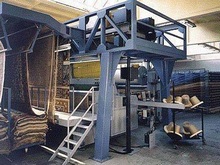
Область примененияWeaving accounts for the major proportion of textiles production for domestic and clothing applications. Whether weft insertion is performed by gripper shuttle, projectile, air or pile wire, the weaving machine depends on high-speed cycles and fast acceleration to ensure productivity. The loom is also characterized by a large number of nonlinear movements and time-critical starting points. This is why the design of a weaving machine is still predominantly mechanical. Electronic equipment has yet to provide a viable alternative in terms of cost or performance for many of the parts on a weaving machine. The weft therefore continues to be inserted mechanically - the reed will also continue to be connected to the main shaft by mechanical means for some time to come. However, the loom already benefits from the flexibility of use and ease of operation associated with electronic systems.
|
ДизайнThe SIMATIC S7 programmable controller:
At the same time, the system decouples many drives on the loom from the main shaft. This makes the machines more flexible and reduces the overall consumption of electrical energy. The warp beam, the regulator for fabric take-off, and the drive for the heald adjustment are all powered by a dedicated dynamic SIMODRIVE servo drive. Pile products and terry toweling can therefore be produced on the same machine as smooth fabrics without having to modify the machine mechanically. The main drive is replaced by an AC-controlled asynchronous motor and the SIMODRIVE converter. A simple torque-controlled asynchronous motor is used for fabric rolling.
|
